Bridging the Talent Gap: A Data-Driven Analysis of Cyber Security Job Market Trends
Mian Afzaal Zahoor (Saint Louis University), Karnika Kuruba (Saint Louis University), Leena Sai Sree Maridi (Saint Louis University), Dr. Maria Weber (Saint Louis University)
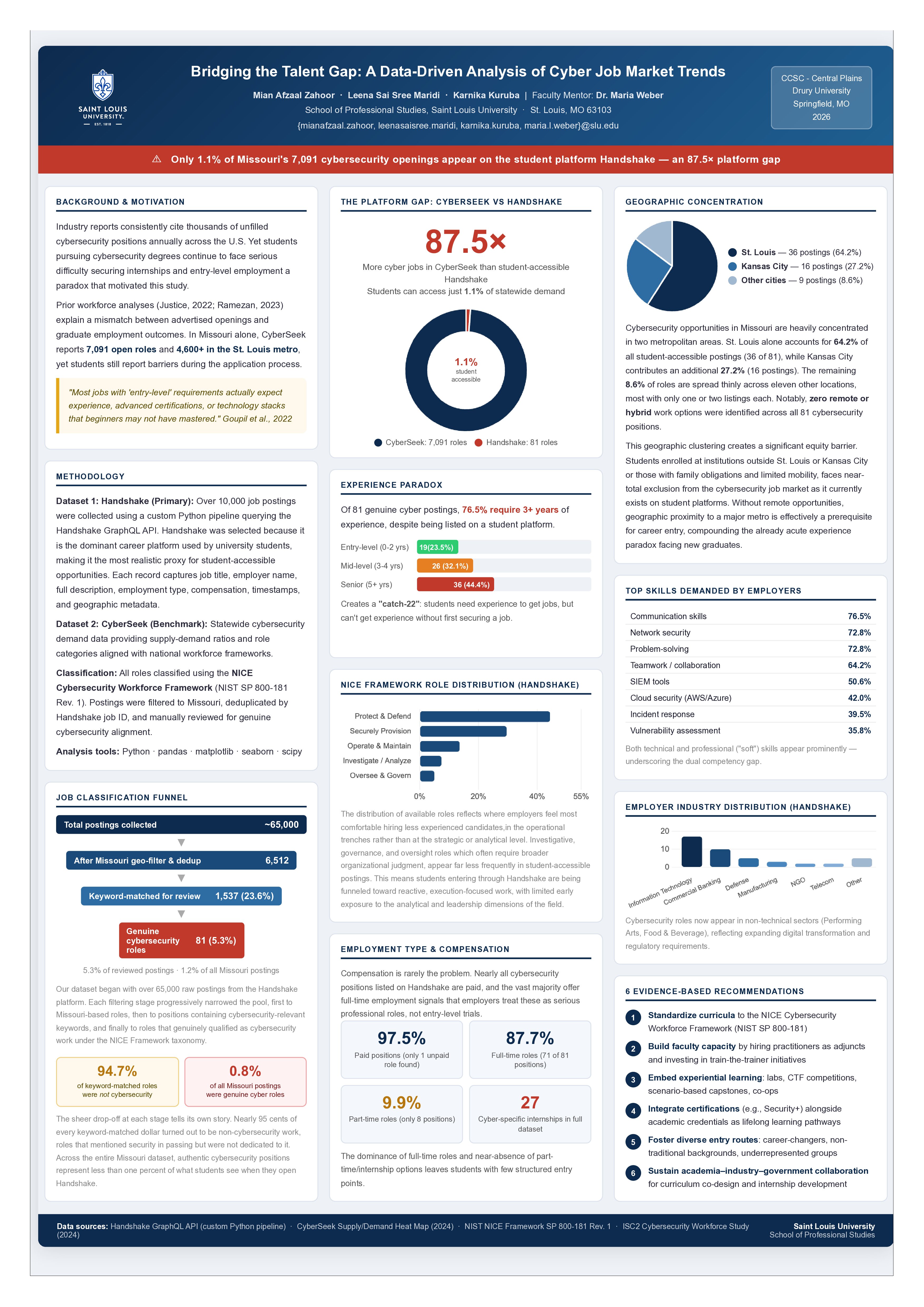
Cybersecurity is widely cited as one of the most in-demand computing fields in the U.S., yet students pursuing cybersecurity degrees consistently struggle to find internships and entry-level employment. This paradox of abundant advertised demand alongside scarce student opportunity motivated a rigorous, data-driven investigation into the structural disconnect between statewide cybersecurity workforce demand and the opportunities actually accessible to university students. This study analyzes two Missouri-scoped datasets: 10,000+ student-facing job postings from the Handshake platform (collected via a custom Python pipeline) and statewide cybersecurity demand data from CyberSeek. After geographic filtering, deduplication, and NICE (National Initiative for Cybersecurity Education) Framework-aligned role classification, we compared the two datasets on role availability, experience requirements, geographic distribution, and employer type. The results expose a dramatic 87.5:1 platform gap: CyberSeek reports 7,091 open cybersecurity positions in Missouri, yet only 81 appear on Handshake, meaning students access just 1.1% of statewide demand through their primary university career platform. Of those 81 positions, 76.5% require 3+ years of experience and 44.4% require 5+ years, creating an acute “experience paradox” where entry-level postings effectively demand mid-career qualifications. Geographic concentration further compounds access: 91.4% of postings cluster in Metropolitan Areas (St. Louis or Kansas City), remote work options are nearly nonexistent, and only 27 cybersecurity-specific internships appear across the full 6,512-posting Missouri dataset. These findings reveal fundamental structural problems in how cybersecurity jobs are advertised and distributed, which disproportionately disadvantage students from rural areas and non-traditional backgrounds. We propose six evidence-based recommendations: NICE Framework curriculum alignment, practitioner-qualified faculty investment, hands-on experiential learning, integrated certification pathways, inclusive entry routes, and sustained academia-industry-government collaboration. This research provides actionable insights for educators, employers, and policymakers working to build a more accessible cybersecurity talent pipeline.