System Architecture for Intelligent Behavior and Procedural Content in Multiplayer Games
Andrew Kassing (Drury University), Elijah Dean (Drury University), Justin Kroh (Drury University), Quinten Johnson (Drury University), Richard Walker (Drury University), Sean Greeley (Drury University), Trevor Blair (Drury University)
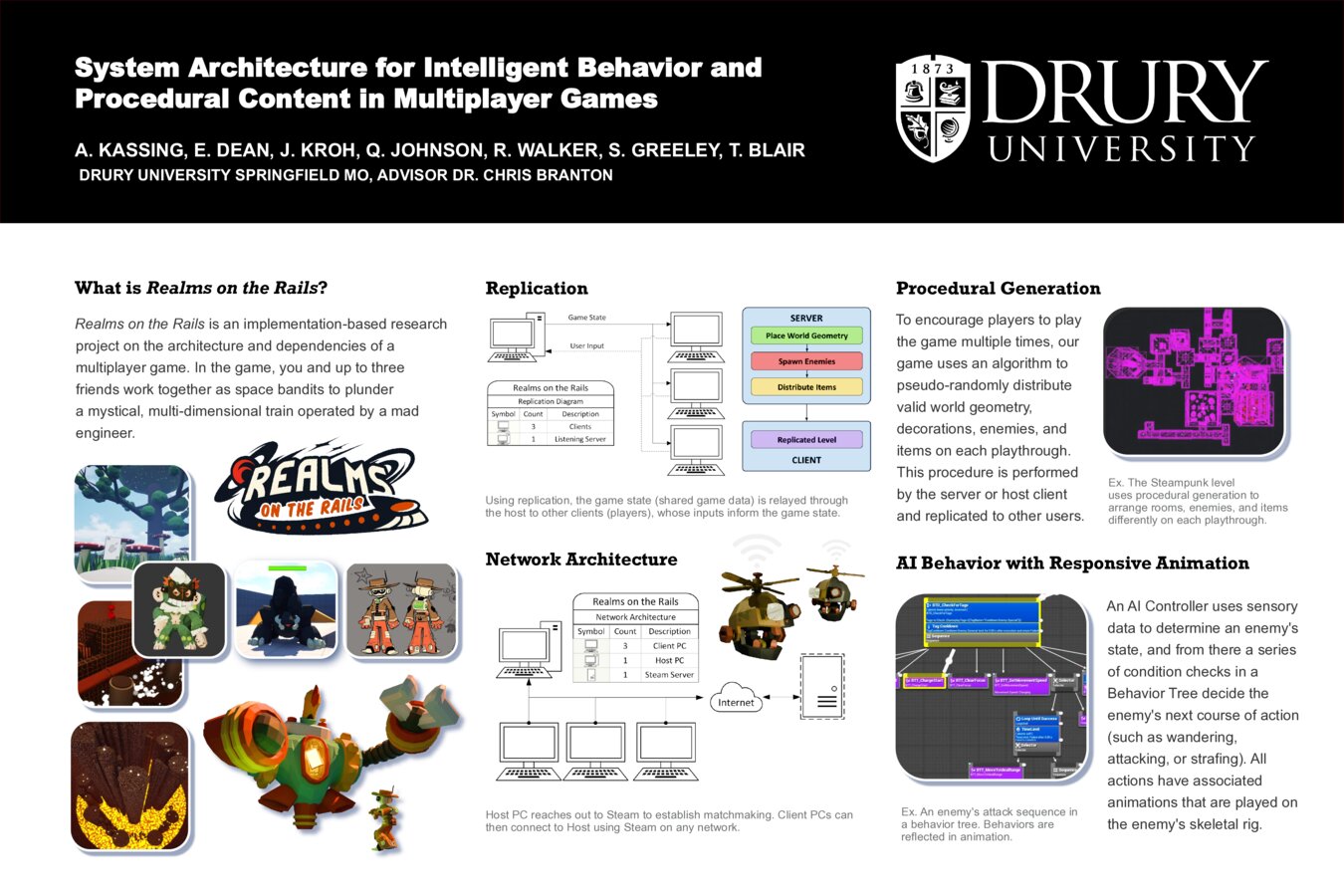
Crafting a video game with responsive, intelligent creatures and a dynamic, procedurally generated environment is daunting in its own right. The difficulties of making such a game compound when these features are implemented in a multiplayer context. This project showcases the development of a game with three core areas of research: networking, AI behavior, and procedural content generation. To develop our game, we used Unreal Engine 5.6.1 and the Steam Online Subsystem. At first, we tried building a multiplayer system architecture centered around a dedicated server, though we switched to a host-to-client listening server after encountering difficulties with both the game engine and our university’s networking infrastructure. Next, we integrated the Steam Online Subsystem to provide players with the ability to create and join lobbies for connected gameplay. Additionally, we designed and implemented artificially intelligent enemies that can navigate terrain and attack players with unique behavior patterns. Enemies are required to account for multiple players, which includes functions for disengaging and changing targets. These behaviors were scripted using Unreal Engine’s behavior trees and Gameplay Ability System. Furthermore, each gameplay environment was built to incorporate procedurally generated content in order to increase the replayability of the game. Procedural elements include level layouts; the placement of powerups, collectibles, and hazards; and the distribution of various enemies. We conducted multiple playtests with various generation algorithms to fine-tune the experience of the game. Lastly, we ensured all players, enemies, and procedural content could be replicated across the network, which enables consistent interactions between players and objects in a shared environment. Our implementation of network replication required extensive research on the architecture of replicating systems, both in general and in Unreal Engine specifically. Our research produced a dynamic, engaging experience for our players. With a functional multiplayer system in place, we wish to explore more advanced methods of implementing intelligent behavior and procedural content. For example, the use of artificial intelligence could produce more sophisticated interactions between enemies and players that do not rely on hand-scripted events, and algorithms could be trained to generate engaging levels with procedural content based upon player enjoyment.